
All sectoral indices ended lower. BSE Telecommunication tanked 2.18 per cent, metal (1.77 per cent), auto (1.70 per cent), energy (1.64 per cent), oil & gas (1.59 per cent), commodities (1.39 per cent) and financial services (1.37 per cent) were the major laggards.

The week's losses wiped out investor wealth worth Rs 18.43 trillion, with the total market capitalisation of BSE-listed firms now at Rs 441 trillion.

India's current account deficit rose sharply in the quarter ended June 30 to $13.7 billion, from $4.5 billion a year ago, due to lower invisible surplus and growth in imports outpacing exports.

'The market's nervousness ahead of anticipated US tariffs has led to a significant downturn in Indian equities.'
The CAD was brought under control in 2013-14 after government imposed restrictions on import of gold. Following, this in 2014, certain restrictions were withdrawn.

'And America will invite India in to have really an extraordinary opportunity and relationship with us.'

The current account deficit widened to $10.1 billion or 2.1 per cent of GDP for the September quarter as against 1.2 per cent in the year-ago period.
The CAD, which is the difference between inflow and outflow of foreign currency, 'widened from 5.4 per cent in Q2 (July-September) to a record high of 6.7 per cent of GDP in Q3, driven mainly by large trade deficit' RBI said in its report on Balance of Payments.

Though trade deficit is expected to 'narrow' in 2013 driven by ongoing curb of gold imports and the gradual removal of fuel subsidies, the deficit will still be 'sizeable', it said.
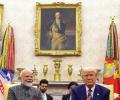
'Modi's intention was to create goodwill that will allow India to be seen by Trump as more than just a bad tariff problem.' 'He succeeded brilliantly on that count but none of these wins are unfortunately permanent.' 'Modi will have to do this again and again if Trump's grievances are to be durably assuaged.'

The finance ministry expects a broad-based moderation in inflationary pressures on the back of an anticipated reduction in food prices as a result of the uptick in summer sowing. The retail inflation rate remained stubbornly clung to the 5 per cent mark in seven of the past eight months. "Core inflation is trending downwards, indicating a broad-based moderation in price pressures... Driven by strong domestic growth and benign global commodity prices, core inflation is declining continuously.
India's current account swung to a deficit for the first time in the current fiscal, with the gap coming at $1.7 billion or 0.2 per cent of the GDP in the December quarter. In the current fiscal, as the pandemic impacted trade, the current account had been in surplus in the previous two quarters, at $15.1 billion and $19 billion, respectively, as per the data on balance of payments released by the RBI on Wednesday. The critical measure of a country's external strength now stands at a surplus of 1.7 per cent of GDP for the first nine months of the fiscal year as against a deficit of 1.2 per cent in the year-ago period. In the December quarter, there was a rise in the merchandise trade deficit to $34.5 billion from $14.8 billion in the preceding quarter, and an increase in net investment income payments.

The government has decided to postpone the release of the new Foreign Trade Policy (FTP) and extend the existing one by six months on account of global uncertainties and currency fluctuations. The government was scheduled to announce the new FTP by the end of September. The current policy was to end on September 30.

'India has the potential to grow at more than 7%, with the monetary policy providing a supportive hand.'

In his speech, PM emphasised on the need to bring India's current account deficit under control and reduce demand for gold and petroleum products.

The current account deficit was estimated at $1.04 billion in January-March. In addition, the surplus on capital account shrunk to $12.96 billion in April-June this year from $17.50 billion in the corresponding period last year due to stock market volatility and lower capital inflows. Net capital inflows fell 23.70 per cent to $13.2 billion during the first quarter this year as foreign institutional investors withdrew $5.18 billion from the country during the first quarter.

'If in our cities, all urban bus transport services are free, then the taxpayers are paying for it, or if electricity were to be made free, that's a huge cost to the rest of the people'

The rupee tumbled 3 per cent against the US dollar in 2024 as concerns over slower economic growth and a stronger greenback in global markets weighed, but it was among the least volatile currencies in the world and the headwinds may be less intense in the coming year.
Although dealing rooms were operational, apart from some big banks, most refrained from trading as there were no retail flow

Apple's ambitious strategy to expand iPhone exports, shift more production from China to India at a faster pace, and grow its domestic market hits a Trump-sized roadblock.

Flagging widening current account deficit as a major risk, the Reserve Bank of India (RBI) on Monday said the government should speed up decision-making and improve business climate to arrest the continuing decline in net foreign direct investment (FDI).
The country's exports in March 2022 rose 19.76 per cent to $42.22 billion on account of healthy performance by sectors such as petroleum products, engineering, and leather, even as trade deficit during the month widened to $18.51 billion. In March 2021, exports stood at $35.26 billion, according to a commerce ministry data released on Wednesday. Last month, imports grew 24.21 per cent to $60.74 billion, it showed. Trade deficit stood at $13.64 billion in March 2021.

The government on Wednesday extended the existing foreign trade policy (FTP) for six more months up to September 30 this year due to the Covid-19 pandemic, according to a notification. FTP provides guidelines for enhancing exports to push economic growth and create jobs. On March 31, 2020, the government had extended the Foreign Trade Policy 2015-20 for one year till March 31, 2021, amid the coronavirus outbreak and the lockdown.
India's goods and services exports have already crossed $675 billion in last fiscal year and the country is now aspiring to take international trade to $2 trillion by 2030, Commerce and Industry Minister Piyush Goyal has said. Interacting with faculty, researchers, and students at the Stanford University here, Goyal also said by the time India would celebrate the 100th anniversary of its independence, it would be a $30 trillion economy. "...by 2047-2050 period, when India would be completing 100 years of Independence, we will be at least a $30 trillion economy on a business as usual scenario and possibly a $35-45 trillion economy if some of the aggressive plans that the government is putting together work well.

Ramesh alleged that the PM "forced" Defence Minister Rajnath Singh to read a "most wishy-washy" statement in Parliament earlier this week

India and China achieved a major milestone this year when their bilateral trade crossed the landmark figure of $100 billion but it did not generate any fanfare in both capitals as the two Asian giants are going through a "particularly bad patch" in their relations due to a set of actions by Beijing in violation of agreements that led to the military standoff in eastern Ladakh. Starting with a modest $1.83 billion in 2001, the bilateral trade crossed $100 billion-mark in the first 11 months this year, a significant milestone for which the two countries carried out campaigns to boost trade and build it as a major stakeholder to improve the relations between two nations, whose ties otherwise remained frosty over the festering boundary dispute and strategic rivalry. According to last month's data from China's General Administration of Customs (GAC), the India-China bilateral trade totalled $114.263 billion, up 46.4 per cent year-on-year from January to November 2021.

Citigroup revised CAD estimates for financial year 2013 to 4.7 per cent from 4 per cent of GDP after incorporating the latest trade and GDP data, and said CAD is likely to stay elevated in financial year 2014 as well.

The government in December had announced incentives for exporters that include extension of two per cent interest subsidy for an additional one year ending March, 2014.

India's exports rose by 43 per cent to $35.65 billion in October while trade deficit widened to $19.73 billion during the month, according to the official data released on Monday. Imports soared by 62.51 per cent to $55.37 billion, widening the trade deficit. Export sectors which recorded positive growth during October include petroleum, coffee, engineering goods, cotton yarn/fabs./made-ups, gems and jewellery, chemicals plastic and linoleum and marine products, the data showed.

Keen to salvage its engagement with Washington DC that has gone southbound ever since the Trump administration came in, India has called for a final set of meetings with US trade officials, soon, reports Subhayan Chakraborty.

It would be a challenge to India's policy makers how to deal with Trump so that mutual economic growth remains sustained and mutual understanding on global issues are not hampered, observes Dr Rajaram Panda.

The government in FY26 Budget should announce an "effective" personal income tax cut to support consumption and demand, Barclays said on Thursday. In its FY25-26 Union Budget preview, Barclays said the key ask from the Budget, to be presented on February 1, is to support growth while adhering to fiscal consolidation path.

Gold prices could hit the $3500 an ounce (oz) mark in the next 18 months - up around 13 per cent from the current levels - given the global uncertainties and aided by investment demand, said analysts at BofA Securities in a recent note. Uncertainty around Trump Administration trade policies, BofA said, could continue to push the US dollar (USD) lower, further supporting gold prices near-term.
The lower CAD was primarily on account of a decline in the trade deficit.

The Reserve Bank of India's (RBI's) $10 billion US dollar-rupee buy-sell swap auction for three years received bids worth $16.23 billion on Friday, reflecting robust demand amid persistent liquidity deficit in the banking system. This was the second swap auction by the central bank after it infused $5 billion via six month-swap on January 31.

'The bull market cycle ran for five years. It's the end of that cycle.' 'The next cycle is a down cycle, and in that down cycle, you will see the Sensex falling from their highs of around 68,000 to maybe 40,000-50,000 at the bottom of the cycle.'

If growth reverts to the pre-Covid level, a lot of people may have to temper their rosy optimism, points out Debashis Basu.

Budget 2025-26 delivers a carefully calibrated strategy-stimulating demand and investment while keeping fiscal discipline intact. In an environment marked by global trade disruptions, and a softening in urban consumption, Finance Minister Nirmala Sitharaman has taken a measured approach.

India's merchandise exports rose by 22.63 per cent year-on-year to $33.79 billion in September on better performance by key sectors like engineering goods and petroleum products, according to official data released on Thursday.

India is not "rethinking" supporting investments from China, said Commerce and Industry Minister Piyush Goyal on Tuesday, referring to a proposal made in the Economic Survey 2024. The survey by India's chief economic advisor last week said India had two "choices" to benefit from the so-called China plus one strategy, either by integrating into that country's supply chain or by promoting foreign direct investment (FDI). "Chief economic advisor's report speaks about new ideas and gives out their own thinking. It is not at all binding on the government and there is no rethinking to support Chinese investments in the country," Goyal told reporters in Delhi.
